
Learning how to sign stand in ASL gives your child a way to communicate before words arrive. “Stand” is the natural partner to “sit” — and toddlers love the contrast game. Two fingers stand upright on a flat palm. Most toddlers manage it between 10 and 14 months.
How to Sign “Stand” in ASL
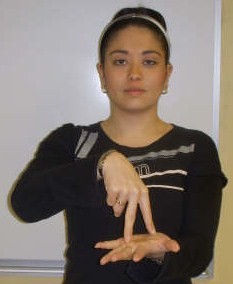
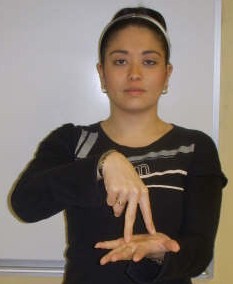
Photos: Rodasmith via Wikimedia Commons, CC BY-SA 3.0
- Make the handshapes: Hold one hand flat, palm up. Make a V-hand with the other.
- Position the V: Hold the V above the flat palm.
- Stand it up: Place the two fingertips on the flat palm, fingers pointing down.
If “sit” is legs dangling from a seat, “stand” is legs planted on the floor.
Step-by-Step Photos
Photos: Rodasmith via Wikimedia Commons, CC BY-SA 3.0
When to Use It With Your Child
- Movement games: Alternate “sit / stand” as a game.
- Getting ready: “Stand up so we can put your shoes on.”
- Transition cues: “Time to stand” before circle time.
Tips for Success
- Teach sit and stand in the same session — the contrast doubles the learning.
- Accept two fingers planted anywhere as a first version.
- Exaggerate the upright posture of the V-fingers.
Signs Related to “Stand”
“Sit” (fingers resting on each other) and “jump” (the V-hand springing off the palm) build a movement vocabulary from one base gesture.
Combining movement games with signs accelerates both motor and vocabulary milestones.
Learn more: National Association of the Deaf — ASL resources and advocacy from the National Association of the Deaf.
Frequently Asked Questions
When should I start teaching my baby how to sign stand in ASL?
You can introduce the sign for stand as early as 10–14 months. Babies understand signs before they can produce them, so start modeling it consistently and reward any attempt — even an approximation — with the item or action right away.
How long does it take for a baby to learn to sign stand?
Most babies begin producing a recognizable version of the sign for stand within two to four weeks of consistent daily modeling. Frequency matters more than perfect form at this stage — sign it every time the word comes up naturally in your routine.
Is the ASL sign for stand the same in baby sign language programs?
Yes. Most baby sign language programs teach the authentic ASL sign for stand. Using real ASL rather than invented gestures means your child’s signs will be understood by Deaf signers and build a foundation for learning more ASL as they grow.