
Non-manual markers are grammatical features of sign language, not merely expressive gestures. When a deaf child raises her eyebrows while signing, she’s not adding emotion to her signing—she’s changing the grammatical structure of the sentence itself. This is the crucial distinction that makes non-manual markers one of the five core phonological parameters of sign language, alongside handshape, movement, location, and palm orientation. Without understanding non-manual markers as grammar, parents and educators miss a fundamental component of how sign language actually works.
Non-manual markers include facial expressions, head movements, body shifts, and mouth morphemes that work together to convey grammatical meaning. For example, the sign HERE with a relaxed face means “this is here,” but the same sign with raised eyebrows and a head tilt asks “is this here?” The marker changes the entire function of the sign. This is not optional embellishment—it’s as essential to sign language as verb tense is to spoken English. Recognizing this distinction helps families and educators understand that sign language children are learning a complete, complex linguistic system from the earliest stages.
Table of Contents
- How Are Non-Manual Markers Different From Expressive Gestures?
- The Five Grammatical Functions That Prove Non-Manual Markers Are Grammar
- Non-Manual Markers in Early Language Development
- Teaching Non-Manual Markers: From Recognition to Production
- The Challenge of Incomplete Non-Manual Marker Systems in Education
- Non-Manual Markers in Modern AI and Digital Sign Language
- The Future of Non-Manual Marker Recognition and Sign Language Development
- Conclusion
How Are Non-Manual Markers Different From Expressive Gestures?
The key difference between grammatical and expressive non-manual markers lies in their consistency and structure. Grammatical non-manual markers display sudden onset and offset with consistent intensity, while expressive markers appear and fade gradually with variable strength. A grammatical question marker (raised eyebrows during a question) starts crisply at the beginning of the question and ends sharply when the question is complete. An expressive smile, by contrast, might gradually appear and linger. This distinction matters because it proves non-manual markers are rule-governed features, not spontaneous emotional responses. Research confirms that non-manual markers function as necessary components of sign language grammar in the same way that manual features do.
Deaf linguists and researchers have documented that these markers have systematic scope and alignment—they cover specific portions of signed sentences and align precisely with the grammatical structures they modify. A child learning sign language is absorbing these rules naturally, just as hearing children absorb the rules of spoken language without formal instruction. Understanding this helps parents and teachers recognize that sign language development includes mastering these grammatical markers, not just learning individual signs. The boundaries between grammar and expression can blur in real usage, but the distinction remains linguistically valid. Some expressive markers can become grammaticalized over time if they develop systematic scope, function, and alignment in the deaf community. However, the core grammatical markers—those used consistently for questions, negation, and other syntactic functions—remain distinct from spontaneous emotional expression. This is why deaf children’s early language exposure should include exposure to consistent, grammatically-correct non-manual markers.

The Five Grammatical Functions That Prove Non-Manual Markers Are Grammar
Yes-no questions in sign language require a specific non-manual marker: raised eyebrows combined with a forward head tilt. Unlike English, which uses pitch rise to signal a question, sign language uses this physical marker to transform a statement into a question. The sign LIKE with neutral eyebrows and no head movement means “I like it.” The identical sign with raised eyebrows and tilted head asks “Do you like it?” This is not variation in expression—it’s structural grammar. Babies exposed to sign language from birth begin recognizing and producing these markers months before they understand the cognitive concept of questioning, much like hearing babies recognize question intonation before understanding what questions are. Wh-questions (who, what, where, when, why, how) use furrowed eyebrows as their grammatical marker. This creates a visual contrast with yes-no questions that helps signers instantly recognize the question type.
Negation presents perhaps the most striking example: the same manual sign can express opposite meanings depending on non-manual markers. The sign WANT with a neutral face and body position means “I want this.” The identical sign with a head shake, furrowed brow, and body withdrawal means “I don’t want this.” These are not two different signs—they’re the same sign with different grammatical marking. Young sign language learners absorb these patterns naturally, developing an intuitive understanding of how non-manual markers modify meaning. A critical limitation to understand: non-manual markers vary across different sign languages and even across different regions using the same language. American Sign Language (ASL) uses specific markers that may differ from markers in British Sign Language (BSL) or other signed languages. Parents and educators need to be consistent with the non-manual markers of the specific sign language community they’re part of, rather than assuming all sign languages mark grammar identically. Inconsistent or absent non-manual markers can actually impede a child’s language development, as it deprives them of essential grammatical information.
Non-Manual Markers in Early Language Development
When deaf infants are exposed to native sign language from birth, they don’t just absorb individual signs—they absorb the complete grammatical system, including non-manual markers. Research in child language acquisition shows that babies as young as 12-18 months begin responding appropriately to questions marked with raised eyebrows, suggesting they’re processing these markers as grammatical signals, not merely perceiving facial expressions. By age two, typically developing deaf children of deaf parents begin producing their own non-manual markers in grammatically appropriate contexts. This parallels how hearing children naturally acquire the intonation patterns of their spoken language without explicit instruction. The implications for families are significant.
When parents and educators use sign language with children, their own use of non-manual markers serves as a language model. Children whose sign language models frequently omit or inconsistently use non-manual markers may develop gaps in their grammatical understanding. Conversely, children exposed to rich, consistent use of non-manual markers develop more sophisticated sign language competence earlier. This is why early exposure to fluent signers—whether parents, teachers, or mentors—is crucial for deaf children learning sign language. The child’s linguistic foundation includes not just vocabulary but the full grammatical system, complete with non-manual marking.

Teaching Non-Manual Markers: From Recognition to Production
Parents and educators often focus on teaching individual signs while overlooking the grammatical markers that make those signs function properly in sentences. A practical approach starts with recognition: helping children notice and understand that raised eyebrows mean a question is being asked, or that a head shake changes meaning. Games and natural conversation can reinforce this awareness without formal “lessons.” When a parent signs a statement and then repeats it with a question marker, the child learns that the same sign can function differently depending on non-manual marking. This mirrors how hearing children learn that “You’re leaving?” functions differently from “You’re leaving.” The comparison between explicit instruction and natural acquisition is important here: while some educators attempt to teach non-manual markers through direct instruction, the most effective approach mirrors natural language learning.
Children acquire these markers best through consistent exposure and natural conversation with fluent signers. However, children with hearing parents or limited access to deaf community members may benefit from explicit attention to these features. Teachers can model consistent use of non-manual markers, point them out when watching signed content, and encourage families to incorporate them into their own signing. The tradeoff is that explicit instruction requires more effort upfront but ensures that even children with limited fluent-signer exposure still develop awareness of these crucial grammatical features.
The Challenge of Incomplete Non-Manual Marker Systems in Education
One significant challenge in educational settings is inconsistency. Some teachers, even fluent signers, may reduce their use of non-manual markers when signing to large groups or when distracted, potentially depriving students of complete grammatical input. Additionally, students who learn sign language as a second language—hearing students or late-deafened individuals—often struggle with non-manual markers because their hearing language background doesn’t include equivalent grammatical structures. They must consciously learn these markers through explicit instruction, a process that differs fundamentally from the natural acquisition experienced by native deaf children. This creates a critical educational consideration: students learning sign language need explicit support in understanding and producing non-manual markers.
Another warning: interpreters and sign language users who learned sign language without strong exposure to native deaf signers may use non-manual markers inconsistently or incorrectly. When such individuals serve as language models for children, they inadvertently provide incomplete linguistic input. This is why seeking out fluent, native-signing deaf mentors and teachers is important for families and educational programs. The limitation is that access to native signers is geographically and economically constrained for many families. Where access is limited, educators should prioritize finding video resources featuring fluent native signers, consulting with deaf community members about correct usage, and being transparent with families about where their non-manual marker models come from.
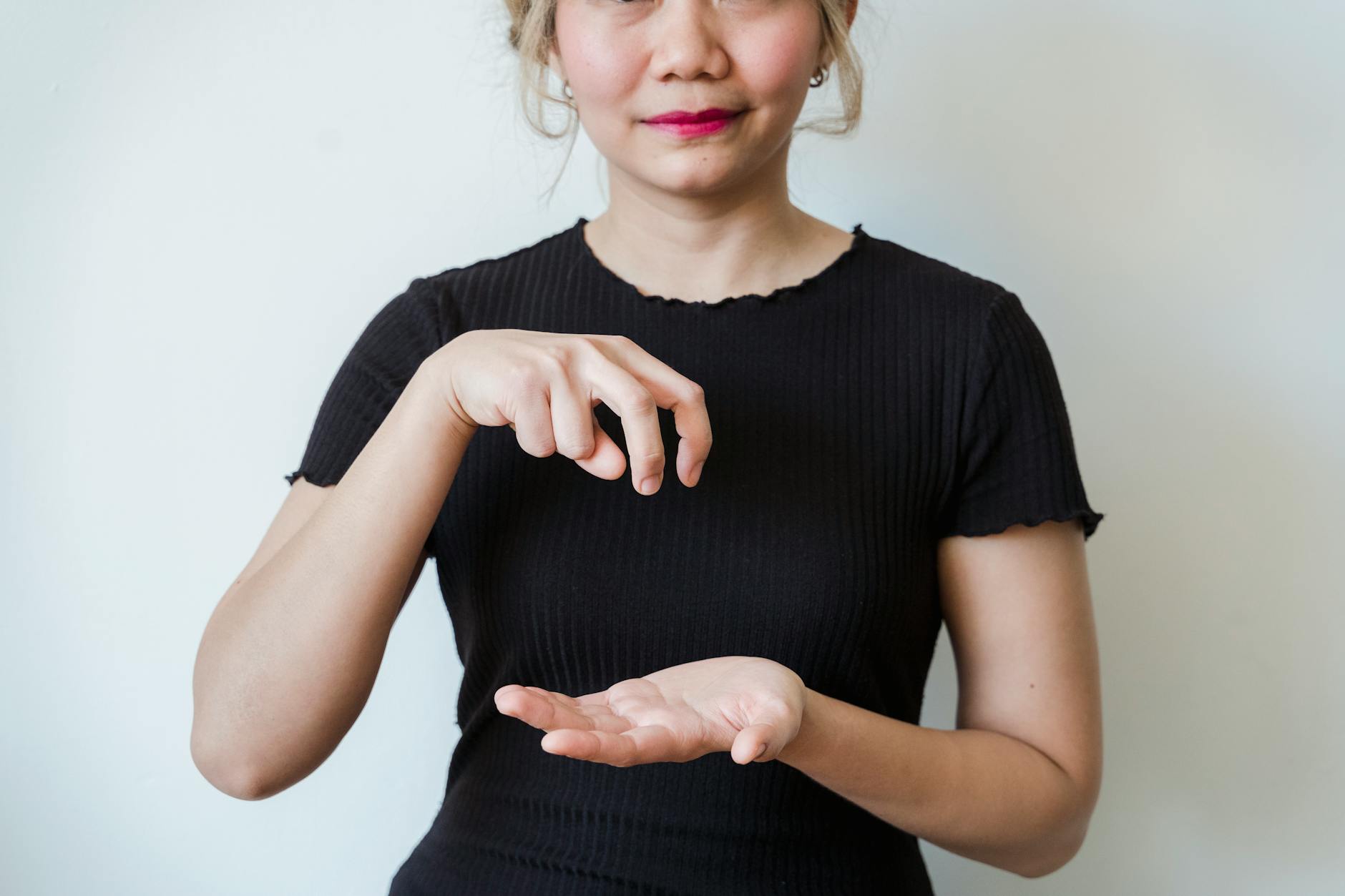
Non-Manual Markers in Modern AI and Digital Sign Language
Recent advances in AI-driven sign language generation have begun incorporating non-manual markers as essential grammatical components rather than optional enhancements. Researchers now recognize that accurate sign language requires including these markers, not just the manual signs. For example, a sign language generation system that produces signs without appropriate non-manual markers would be linguistically incomplete and potentially confusing to deaf users. This technological development validates decades of linguistic research showing that non-manual markers are fundamental grammar, not decoration.
Parents watching educational videos with AI-generated or video-modeled sign language should look for consistent, grammatically-appropriate non-manual markers as one indicator of quality. This also means that resources for sign language learning are becoming more sophisticated in their representation of the full grammatical system. Educational apps and videos that include non-manual markers provide more complete linguistic input than those that focus only on manual signs. As technology evolves, family expectations for sign language resources can include this grammatical completeness.
The Future of Non-Manual Marker Recognition and Sign Language Development
As sign language linguistics continues to develop, our understanding of non-manual markers becomes more nuanced and detailed. Research into specific regional variations and their development in children will likely refine how educators and parents understand and teach these features. The recognition that non-manual markers are grammar, not expression, has shifted how sign language is documented, taught, and preserved.
This shift benefits all learners, but especially young deaf children whose foundational language exposure shapes their lifelong communicative competence. The broader implication is that sign language is receiving the linguistic respect it deserves. Non-manual markers are no longer dismissed as optional emotional expression but recognized as core grammatical features. This recognition elevates the status of sign language as a complete, complex language and emphasizes the importance of providing children with complete, grammatically-rich language models from the earliest stages of development.
Conclusion
Non-manual markers are grammatical features of sign language that carry the same linguistic weight as manual signs themselves. They mark yes-no questions with raised eyebrows and forward head tilt, wh-questions with furrowed brows, negation with head shakes, and numerous other grammatical functions. Understanding that these markers are grammar—not merely emotional expression—changes how we approach sign language exposure, education, and assessment.
Families and educators who recognize non-manual markers as essential grammar rather than optional embellishment can better support deaf children’s language development and ensure they receive complete linguistic input. For parents raising a deaf child in sign language, the takeaway is clear: expose your child to fluent signers who use consistent, grammatically-appropriate non-manual markers. This may mean seeking out deaf community mentors, choosing educational resources that feature native signers, and learning these markers yourself if you’re developing your sign language skills. The effort to ensure your child receives complete, grammatically-rich sign language input—including all non-manual markers—supports their development as a fluent, competent sign language user from infancy onward.